


Amateurs
RE/MAX World Long Drive – Final
Golf Strongmen Arrive

- The big final has arrived, from 17 to 25 October 2012 in Mesquite (Nevada, USA), with Gerard Pera as the only Spanish participant.
October 12, 2012 – Although it’s not a circus, the atmosphere is full of music, balloons, excitement, shouts, applause… and some strong men who leap to the stage to show off their strength. They’re not lifting heavy black dumbbells… but measuring their power by hitting tiny white balls, which weigh 45.93g and have a diameter of 42.67mm, with a golf club, to send them beyond 400 yards… unless they explode in the attempt. This is a 21st century sport with rhythm and speed, action-packed and full of adrenaline.
The Long Drive is a competitive sport in which success lies in hitting the golf ball with a driver and sending it as far as possible. In other works, the impetuous craving all we amateur golfers have for smashing the ball as far as possible from the tee. Who doesn’t hit balls on the driving range with the hope of improving their talent in this aspect of the game? Well, turn it into a competition for professionals and there you have the RE/MAX World Long Drive Championships.
The best hitters from around the world have their next meeting from 17 to 25 October in Mesquite (Nevada, USA), battling for bragging rights and $500,000 in prize money. Also known as the World Long Drive Championship, REMAX World Long Drive, RE/MAX WLDC or REMAX, this is the world championship final of long drives, which started in the U.S. back in 1975. The Long Drivers of America (LDA) took over the event in 1995, and RE/MAX became the official sponsor that year, leaving the former National Long Drive Championship to be organized by Golf Digest.
Statistical Comparison
You might find it impressive to watch Alvaro Quiros or Nicolas Colsaerts in tournaments on the European Tour, and Bubba Watson and Dustin Johnson on the PGA Tour, averaging 315 yards (288m) in driving distance. But what comes to mind if I tell you that Long Drive professionals average over 350 yards (320m), and often exceed 400 yards (365m). The American Mike Dobbyn, Long Drive Champion in 2007, is the professional who holds the world record for the longest drive in history, with 551 yardas (504m), an exceptional record, even though most of his hits range between 350 and 450 yards (320 and 411m). Amazing, isn’t it? Although Mike has the advantage of being quite a physical marvel, 6’8” tall and 310.5 pounds in weight.

An emerging golf modality in Europe
The Long Drive is a little known form of golf in Spain and Europe, a fact that will change soon with the recent creation of the European Long Drivers Association, which has its origin in the only event of the world circuit held this year in Europe, organized last September 8th at the PGA Catalunya Resort (Girona, Spain). On its way through Spain, the circuit called up the most powerful Europeans hitters, leaving the stamp of this spectacular golf modality, which certainly allowed us to see, in the flesh, some real ‘golf strongmen’.
Many of them are part of the group of Europeans who have qualified for the finals of the World Long Drive in Mesquite, among which are the Britain golfers Dan Konyk (winner at the PGA Catalunya) and Joe Miller (world champion in 2010), the Swedish players Andreas Persson and Jorgen Trank alongside Gerard Pera, fifteenth in the world and the only Spanish professional Long Drive player, who achieved his personal record at the PGA Catalunya with a drive of 395 yards (361m).
How the competition works
There are some 120 players registered to decide who is the ‘world’s longest golfer’ of 2012 in Mesquite, a complex that has been specially prepared to host the event, which features a flat surface and a perimeter 60 yards wide and 450 yards long. Competitors have six attempts to hit the ball as far as possible in just two minutes and 45 seconds. After a few rounds to define the order of play, the one-to-one knockout phase begins. Every golfer shoots six drives in each round, and the longest hit determines whether he goes on to sixteenths, eighths, quarters, semis and final. The ball has to fall within the limits, and the longest lie of these 6 balls is what counts.
Obviously, this is not a championship of subtlety and style, but it has become the most spectacular golfing event that can be seen today. The importance lies not only in the distance the ball goes, but also in the degree of skill and accuracy that the golfer displays. Unlike the pause and silence demanded by the Tour pros, these players look to the public for energetic ambience and shouts of encouragement to get the adrenaline pumping for every shot.

Fitted equipment
The Long Drive clubs, always drivers, are different from the clubs of the average golfer in a number of ways. They coincide in volume and coefficient of restitution, with 460cc and the limit of 0.83 (COR), but the loft is usually lower, sometimes even at 4 ° or 5 °, compared to the usual 10.5 º of the amateur player. In terms of length, they use shafts which are much longer than normal. Whereas we use shafts of 45 inches (114.3 cm), the rules allow them to play up to a maximum of 50 inches (127.0 cm), measured vertically. They are usually made of graphite, but another big difference is the stiffness, as flexibility leads to a loss of control. The kick point or bending point is also higher for a lower trajectory relative to the player’s swing speed, and a lower torque, so that the clubhead arrives straighter to the impact.

 For example Gerard Pera, the best Spanish specialist, tried out 20 drivers of various brands and specifications, assembled at Depique golf shop (Barcelona) and analysed with the TrackMan radar, until he found what suited him. Testing Callaway, Krank, Adams… with lofts from 4.5° to 8°, the end result is a Callaway RAZR Fit Driver of 8.5º loft, closed to 7º in the Open settings, with a Pro Lite Long Drive special shaft of 48-inches, 3.29g, E450 swing-weight and 295 CPM (Cycles Per Minute).
Specific training
When we have got the required technique, and sufficient physical preparation, we can then play an 18 holes golf course. But for Long Drive players, more strength and power is required, along with superior hand-eye coordination to achieve these incredible distances. So they have to follow different patterns of training. The ball speed reaches almost twice that of an amateur golfer. Gerard Pera compares it to the javelin throw or the shot put in athletics. So, Long Drivers spend almost more time in the gym than in the course.
“Good Long Drive players do 30/40% technical preparation, and 70/60 % physical training in the gym,” says Gerard Pera. “That doesn’t mean just doing weightlifting, it also means working on elasticity, because even if they’re very corpulent, they’ve got to bend a lot, and they also need to get a lot of massage to avoid injuries.”
Faced with the challenge of the Long Drive, aspirants have to follow a specific plan leading up to the tournament. “To prepare for a championship you need a minimum of 3-4 weeks to perform well in the competition,” adds the Spanish Long Driver player. For example, Gerard does 2 to 3 hours of technical preparation and 2 to 3 hours of physical workout every day. “I use the short game for the warming-up, so that I don’t lose the feeling.” Not all Long Drive golfers come from playing in the Tour, as Gerard, who still retains his ability to be competitive in a round of golf. “Most of those who play in the Long Drive are not pros from tournaments.”
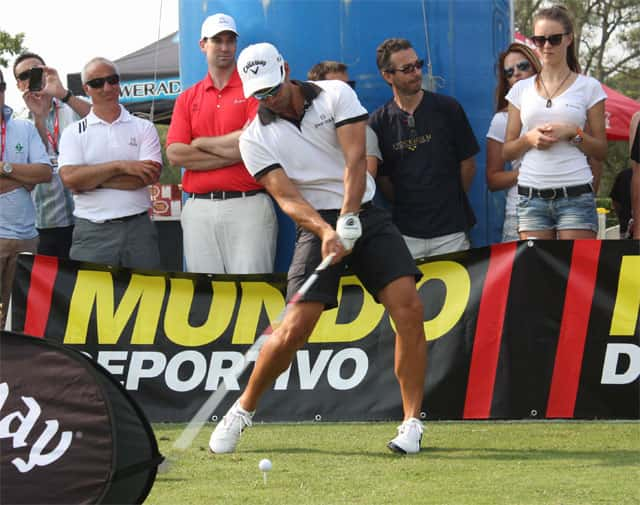
New drug testing policies and procedures for Long Drivers of America-sanctioned events are on this year for drug free sport, as well as launching an educational initiative for power golfers.
Care during competition
During the competition at the PGA Catalunya Resort, all professional players went through the Golf Performance Centre’s bay installed on the driving range to provide service to them. Between one round of hits and another, golfers receive massage on a table, and can also tune their swing and distance from the Trackman radar.
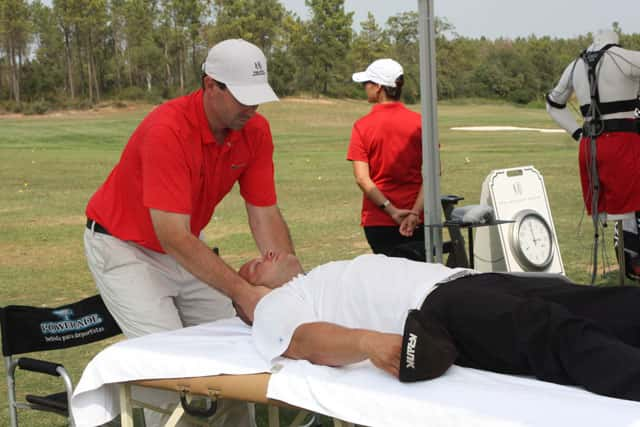
“Its necessary for these players to have the massages and to keep hitting balls between the heats,” said September Woods, head of the Golf Performance Center of PGA Catalunya Resort. “Each player will have shot approximately 600 to 700 golf balls by the end of the day, and they come here because between qualifying rounds they need to maintain their body temperature and not get cold.” According to the Trackman, these players move the driver at an average speed of 135 to 145 mph.
An unorthodox swing
We want to know more about the differences between the swing of a Tour professional and a Long Drive professional.
“The swing has the same kinetic sequence,” adds September Woods. “The energy always comes from the ground. Long Drive players have wider bodies, they don’t play on the course but only off the tee. They require a lot of muscles to generate power, and also great flexibility. They only focus on the driver, because their only objective is distance”. Anecdotally, September says that these strongmen are able to reach 200 yards hitting the golf ball with a putter!
Indeed, Long Drivers are characterized by their power and speed. But their swing doesn’t look very orthodox, their heads move about and their front foot opens out at the end of the movement. “It’s true. They have to move their head a little more because of the speed. They are like a Ferrari. Because the speed has no brakes, and the joints are the worst sufferers, they have to rotate their foot, otherwise they could break their knees.” This reminds us of Tiger Woods’ knee injury in 2008.
Good luck to all the participants, looking for the prize of $500,000, and specially to Gerard Pera, in the Final of the RE/MAX World Long Drive Championship, 2012.
Here are the winners of the past editions:
| YEAR | NAME | COUNTRY | DISTANCE |
| 1995 | Sean Fister | USA | 362y |
| 1996 | Jason Zuback | CAN | 351y |
| 1997 | Jason Zuback | CAN | 412y |
| 1998 | Jason Zuback | CAN | 361y |
| 1999 | Jason Zuback | CAN | 373y |
| 2000 | Viktor Johansson | SWE | 315y |
| 2001 | Sean Fister | USA | 376y |
| 2002 | Carl Wolter | USA | 384y |
| 2003 | Clayton Burger | USA | 402y |
| 2004 | David Mobley | USA | 377y |
| 2005 | Sean Fister | USA | 377y |
| 2006 | Jason Zuback | CAN | 368y |
| 2007 | Mike Dobbyn | USA | 385y |
| 2008 | Jamie Sadlowski | CAN | 418y |
| 2009 | Jamie Sadlowski | CAN | 384y |
| 2010 | Joe Miller | GBR | 414y |
| 2011 | Carl Wolter | USA | 409y |
| 2012 | ¿? |

DAN KONYK, JORGEN TRANK, JOE MILLER AND GERARD PERA, FOUR OF THE EUROPEAN COMPETITORS AT THE FINAL OF 2012 WORLD LONG DRIVE CHAMPIONSHIP. Picture: ©MyGolfWay.com
More information at:
CHAMPIONSHIP SCHEDULE OF EVENTS
COMPETITORS